Tag: Appointed Person

  • Momofuku: A Noodle Bar Drama

    Momofuku: A Noodle Bar Drama

    Case Name: Nissin Foods Holdings Co., Limited v MomoIP LLC

    Citation: [2025] EWHC 561 (Ch)

    Judge: Iain Purvis KC, sitting as a Deputy Judge of the Chancery Division

    Decision: Here

    Trade Marks

    Nissin Foods Trade MarksMomo IP’s Trade Marks
    NoPriority / Filing DateCNoPriority / Filing DateC
    ITM 141809126 Oct. 201729, 30UKTM 906646558 (‘558)6 Feb. 200843
    UKTM 80141809126 Oct. 201729, 30UKTM 357544506 Jan. 202143
    UKTM 378100025 April 202229, 30ITM 162417122 Sept. 202143

    Summary

    In an appeal from the Hearing Officer to the High Court, Mr Purvis KC (sitting as a Deputy Judge) has held that MomoIP’s UK trade mark ‘558 for MOMOFUKU was not put to genuine use, providing useful guidance on the application of the law of genuine use in the United Kingdom.

    Background

    Nissin Foods is a food company founded by Momofuku Ando in 1948 in Osaka, Japan, known for the development of the world’s first instant noodles chicken ramen.

    MomoIP is the holding company for the MOMOFUKU culinary brand, which was established by chef David Chang in 2004 in New York, USA. Mr Chang’s steamed bao and ‘meaty’ tasting vegetarian chickpea hozon ramen were the cuisine du jour in the 2010s. Bar a pop-up in Shoreditch, it does not have any UK restaurants.

    Nissin Foods and MomoIP registered (and applied for) trade marks in the United Kingdom for MOMOFUKU in classes 29 and 30 and class 43 respectively. Nissin Foods subsequently brought three actions challenging the validity of some of MomoIP’s trade marks and MomoIP in turn brought three actions challenging the validity of some of Nissin Foods’ trade marks and applications.

    On appeal only one issue remained, namely whether MomoIP’s trade UKTM ‘558 (the original registration of the six subject to the proceedings) had been put to genuine use within the United Kingdom during the relevant period. 

    Law

    In easyGroup Ltd v Nuclei Ltd & Ors [2023] EWCA Civ 1247, Arnold LJ summarised the law relating to genuine use:

    106.  … the principles may be summarised as follows:

    (1)  Genuine use means actual use of the trade mark by the proprietor or by a third party with authority to use the mark…

    (2)  The use must be more than merely token, that is to say, serving solely to preserve the rights conferred by the registration of the mark …

    (3)  The use must be consistent with the essential function of a trade mark, which is to guarantee the identity of the origin of the goods or services to the consumer or end user by enabling him to distinguish the goods or services from others which have another origin …

    (4)  Use of the mark must relate to goods or services which are already marketed or which are about to be marketed and for which preparations to secure customers are under way, particularly in the form of advertising campaigns … Internal use by the proprietor does not suffice … Nor does the distribution of promotional items as a reward for the purchase of other goods and to encourage the sale of the latter … But use by a non-profit making association can constitute genuine use …

    (5)  The use must be by way of real commercial exploitation of the mark on the market for the relevant goods or services, that is to say, use in accordance with the commercial raison d’être of the mark, which is to create or preserve an outlet for the goods or services that bear the mark…

    (6)  All the relevant facts and circumstances must be taken into account in determining whether there is real commercial exploitation of the mark, including: (a) whether such use is viewed as warranted in the economic sector concerned to maintain or create a share in the market for the goods and services in question; (b) the nature of the goods or services; (c) the characteristics of the market concerned; (d) the scale and frequency of use of the mark; (e) whether the mark is used for the purpose of marketing all the goods and services covered by the mark or just some of them; (f) the evidence that the proprietor is able to provide; and (g) the territorial extent of the use …

    (7)  Use of the mark need not always be quantitatively significant for it to be deemed genuine. Even minimal use may qualify as genuine use if it is deemed to be justified in the economic sector concerned for the purpose of creating or preserving market share for the relevant goods or services. For example, use of the mark by a single client which imports the relevant goods can be sufficient to demonstrate that such use is genuine, if it appears that the import operation has a genuine commercial justification for the proprietor. Thus there is no de minimis rule …

    (8)  It is not the case that every proven commercial use of the mark may automatically be deemed to constitute genuine use …

    Hearing Officer’s Decision

    The Hearing Officer concluded that UKTM ‘558 had been put to genuine use. In doing so she relied on the following during the relevant period (21 April 2017 to 20 April 2022) to support her decision:

    • Cookbook Sales: She noted that over 2,600 copies of the MOMOFUKU cookbook had been sold via Amazon.co.uk, although this was later found to be incorrect as it referred to reviews, not sales.
    • Website Traffic: MomoIP’s US website received traffic from the UK, with varying numbers of visits over the years.
    • Pop-Up Events: MomoIP ran a 2-day MOMOFUKU pop-up restaurant in Shoreditch, London, which was sold out and served 96 customers.
    • Promotional Activities: MomoIP partnered with Nike to create a special edition trainer, although there was no evidence of sales in the UK.
    • Customer Base: The UK was the 4th largest customer base for MOMOFUKU’s restaurants in the USA, with many UK-based followers on Instagram and customers on its email distribution list 2021.

    Appeal

    Mr Purvis KC, found that the Hearing Officer’s decision was vitiated by a series of errors of fact and illogical assertions not justified by the evidence before her. He reasoned as follows:

    • The Hearing Officer misunderstood the evidence relating to the Amazon listing of the MOMOFUKU cookbook, suggesting that thousands of copies had been sold when there was no such evidence.
    • The Hearing Officer took into account three pop-up events when in fact there was only one relevant event in Shoreditch, with little or no evidence of promotion of the New York restaurant.
    • The evidence of the Nike trainers should never have been relied on, as it established effectively nothing.
    • The Hearing Officer’s attempt to link these promotional activities to the reputation of the MOMOFUKU restaurants amongst UK consumers was illogical and not justified by the evidence.

    The judge therefore concluded that the appeal succeeded and ‘558 had not been put to genuine use.

  • Brand Interchange

    Brand Interchange

    Our first newsletter is now out. The newsletter is designed
    to be essential reading for all inhouse
    brand lawyers, providing
    news, case updates and events in
    the United Kingdom. This month, we
    address 3D shapes and the latest
    instalment in the Slush Puppie Wars.

  • Tapper v Beak Fried Chicken

    Tapper v Beak Fried Chicken

    Court: Appointed Person

    Judge: Dr Brian Whitehead

    Judgment: Here

    Trade Mark: UK3380292, UK3120818, UK3815842, UK3849951

    Issue: Trade Mark Invalidity

    Summary

    In Tapper v Beak Fried Chicken, the Appointed Person has provided guidance on when a party may resile from an admission, upholding Tapper’s appeal and remitting the matter to the Hearing Officer for consideration.

    Trade Marks

    Hearing Officer

    The Hearing Officer heard two consolidated oppositions, Tapper’s opposition in relation to Beak Fried Chicken’s UK ‘842 and Beak Fried Chicken’s corresponding opposition in relation to Tapper’s UK ‘951.

    The Hearing Officer concluded that Tapper’s opposition was successful under s. 5(2)(b) of the Trade Marks Act 1994 and so the registration proceeded only in relation to “retail services relating to stationery, namely stickers”.

    As to Beak Fried Chicken’s opposition, the Hearing Officer relied on an admission by Tapper in its TM8 counterstatement that the services in class 35 were identical with those for which UK ‘951 was to be registered.  He concluded that, because the marks were visually similar to a medium degree, aurally identical and conceptually similar to a high degree there was a likelihood of confusion.

    As a result, he refused registration for the certain services in class 35 including: “Advertising, marketing, promotion and / or retail … of key rings, pens, books on brewing beer, beer mats, etc.”

    Appointed Person

    Tapper appealed the Hearing Officer’s decision, arguing that the admission in its TM8 counterstatement was in respect only of the challenged services in the ‘842 mark.

    The Appointed Person disagreed, finding that there was no ambiguity in the TM8 counterstatement, which read:

    “The Applicant accepts that the word element is identical, however the Applicants mark has a strong and distinctive visual identity. The Applicant accepts that the services in Class 35 are identical.”

    Tapper further argued that it was contrary to Registry practice and procedure for the Hearing Officer to continue on the basis of identicality when this was wrong as a point of fact.

    Here, the Appointed Person disagreed with the appellants reasons, citing §4.1 of Contentious Trade Mark Registry Proceedings (2nd Edition):

    “If an allegation is admitted, then that fact or matter is no longer in issue between the parties, and so (a) no evidence needs to be adduced to establish it; (b) no argument needs to be advanced to promote or defend it; and, (c) the tribunal need not trouble itself about it, as it becomes an agreed point between the parties and may be used by the tribunal as a basis for its decision”.

    However, the Appointed Person found that the Hearing Officer had erred by not investigating with Tapper as to whether it wished to resile from the admission. He pointed to CPR 14.5, which explains that a Court can give permission to withdraw or qualify an admission. In doing so, the Court should consider:

    “(a)  the grounds for seeking to withdraw the admission;

    (b)  whether there is new evidence that was not available when the admission was made;

    (c)  the conduct of the parties;

    (d)  any prejudice to any person if the admission is withdrawn or not permitted to be withdrawn;

    (e)  what stage the proceedings have reached; in particular, whether a date or period has been fixed for the trial;

    (f)  the prospects of success of the claim or of the part of it to which the admission relates; and

    (g)  the interests of the administration of justice”.

    As a result, the Appointed Person remitted the matter to the Registry for consideration of whether Tapper should be permitted to resile from or qualify the admission of identicality of services made in its TM8 counterstatement

  • De Longhi v Ronix

    De Longhi v Ronix

    Court: Appointed Person

    Judge: Emma Himsworth KC

    Judgment: Here

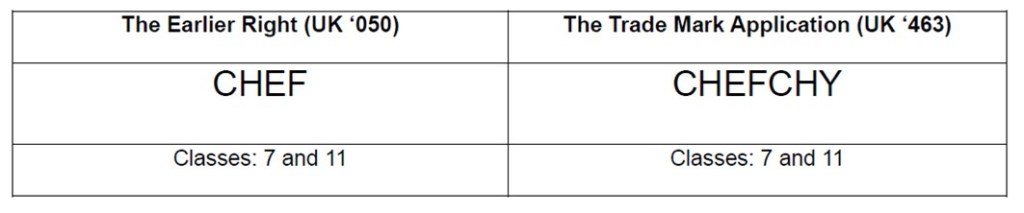
    Trade Mark: UK00003740463 (CHEFCHY)

    Issue: Trade Mark Invalidity

    Summary

    In De Longhi v. Ronix, the Appointed Person has upheld the Hearing Officer’s decision that Ronix’s application UK ‘463 for CHEFCHY in classes 7 and 11 was valid over De Longhi’s earlier mark, UK3438050, for CHEF in the same classes.

    Opposition

    De Longhi opposed the registration on the basis of ss. 5(2)(b), 5(3) and 5(4)(a) (passing off) of the Trade Marks Act 1994.

    The Hearing Officer found for Ronix, concluding as follows:

    • Reputation and distinctiveness: The Hearing Officer found that UK ‘050 had a moderate reputation in the UK for food mixers and their attachments. However, its distinctiveness was no more than a medium level overall.
    • Similarity between the marks: The Hearing Officer concluded that there was a moderate degree of similarity between the competing marks overall.
    • Similarity of goods: The Hearing Officer found that the goods for which UK ‘050 was registered, such as electric kitchen tools and utensils, were similar to a medium to high degree to the goods for UK ‘463, such as food mixers and their attachments.
    • Overall: Taken together the differences between the marks, such as the additional letters “CHY” in the contested mark, were sufficient for the average consumer to distinguish between them and avoid confusion.
    • Section 5(3) and 5(4)(a): The Hearing Officer dismissed De Longhi’s claims under these sections, finding no evidence of unfair advantage, detriment, or passing off.

    The Appointed Person

    The opponent appealed the Hearing Officer’s decision on several grounds:

    • Errors in the Assessment of Reputation and Distinctiveness: The opponent claimed that the Hearing Officer overlooked certain evidence and should have found a higher degree of acquired distinctiveness for their earlier mark.
    • Errors in the Assessment of Similarity of Goods: The opponent argued that the Hearing Officer should have found the goods to be identical or highly similar, rather than just similar to a medium to high degree.
    • Errors in the Assessment of Likelihood of Confusion: The opponent contended that the Hearing Officer made errors in assessing the likelihood of confusion between the marks.
    • Errors in the Assessment of Section 5(3) and 5(4)(a): The opponent maintained that the Hearing Officer should have considered unfair advantage, detriment, and passing off.

    The Appointed Person reviewed the decision and found no material error in the Hearing Officer’s assessment, dismissing the appeal and upholding the Hearing Officer’s decision.

  • Elbisco v Kerangus (BL O/0111/25)

    Elbisco v Kerangus (BL O/0111/25)

    Court: Appointed Person

    Judge: Philip Harris

    Judgment: Here

    Trade Mark: UK00003651180

    Issue: Trade mark validity

    Summary

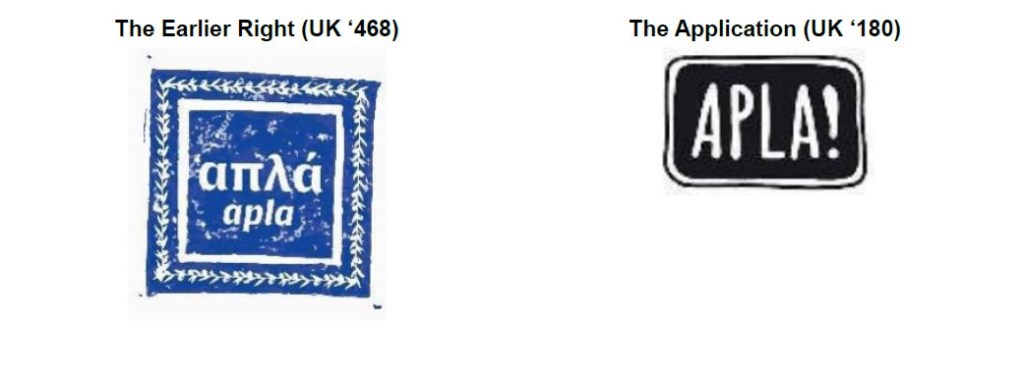
    In Elbisco v Kerangus, the Appointed Person has upheld the Hearing Officer’s decision that Kerangus’ application for UK00003651180 (below) in classes 29 and 30 should not be registered in light of Elbisco’s earlier registration UK00003255468 (also below) in class 30.

    The decision provides a useful analysis of the average UK consumer’s approach to signs with Latin and non-Latin letters (in this instance Greek).

    Background

    On 4 June 2021, Kerangus applied for UK ‘180 in classes 29 and 30, including certain food products. Some six months later, Elbisco opposed the application relying on its earlier right, UK ‘468, registered for class 30, again including certain food products.

    In response, Kerangus defended the opposition and commenced a cancellation action. Here, it challenged the validity of UK ‘468 (which includes the words απλά and APLA) on the basis of its earlier registration UK0003700115 (which includes a stylised version of απλά), depicted below. UK ‘468 was registered in classes 29 and 30 for certain food products.

    In both instances, the parties relied on s. 5(2)(b) of the Trade Marks Act 1994.

    Hearing Officer

    The proceedings having been consolidated, the Hearing Officer concluded that:

    • The vast majority of average UK consumers would not understand Greek characters;
    • As a result, the average consumer would deem Kerangus’ ‘115 mark to comprise the word element ANNA (not απλά);
    • Further, the average consumer would consider the dominant element of ‘468 to be APLA (as απλά would not be readily articulable by the consumer);
    • As a result, ‘115 and ‘468 were visually and aurally similar to only a very low level and conceptually different;
    • While the goods for which the respective marks were, in part, identical or similar, given the lack of similarity of the marks, there was no likelihood of confusion;
    • By comparison, the Hearing Officer held that, where APLA was the dominant element of both ‘468 and ‘180, they were visually similar, aurally identical and conceptually neutral;
    • Where the goods were, in part, identical or similar, there was a likelihood of confusion;
    • It followed that UK ‘468 remained valid, but UK ‘180 was not in relation to certain goods.

    Appointed Person

    Kerangus appealed on several grounds, including flaws in the assessment of the overall impression of the marks, visual and aural comparison, and likelihood of confusion.

    Where the grounds of appeal were primarily a submission that the Hearing Officer’s assessment was wrong in fact, not law, the Appointed Person was unwilling to deviate from the Hearing Officer’s conclusions.

    In particular, the Appointed Person emphasised that an appeal is by way of review, not re-hearing. This was recently summarised by the Court of Appeal in Lidl Great Britain Ltd v Tesco Stores Ltd [2024] EWCA Civ 262, where Arnold LJ as follows:

    “110. It is common ground that, in so far as the appeals challenge findings of fact made by the judge, this Court is only entitled to intervene if those findings are rationally insupportable: Volpi v Volpi [2022] EWCA Civ 464, [2022] 4 WLR 48 at [2] (v) (Lewison LJ). Equally, it is common ground that, in so far as the appeals challenge multi-factorial evaluations by the judge, this Court is only entitled to intervene if the judge erred in law or principle …”

    The appropriate approach to be adopted by the appellate court was summarised in Axogen Corporation v Aviv Scientific Limited [2022] EWHC 95 (Ch):

    “24. Although I was referred to numerous cases on the subject …. the approach of the appeal court to a statutory appeal under section 76(1) of the TMA is uncontroversial. I bear the following principles, relevant to the issues before me, firmly in mind:

    i) The appeal is by way of a review, not a rehearing;

    ii) The appeal court will allow an appeal where the decision of the lower court was “wrong” (see CPR 52.11). Neither surprise at a Hearing Officer’s conclusion, nor a belief that he or she has reached the wrong decision suffices to justify interference;

    iii) The decision of the lower court will be “wrong” if the judge makes an error of law, which might involve asking the wrong question, failing to take account of relevant matters or taking into account irrelevant matters. Absent an error of law, the appellate court would be justified in concluding that the decision of the lower court was wrong if the judge’s conclusion was “outside the bounds within which reasonable disagreement is possible”;

    iv) The approach required by the appeal court depends on a number of variables including the nature of the evaluation in question. There is a “spectrum of appropriate respect for the Registrar’s determination depending on the nature of the decision”, with decisions of primary fact at one end of the spectrum and multi- factorial decisions (of the type which the parties agree were made in this case by the Hearing Officer) being further along the spectrum.

    v) In the case of a multifactorial assessment or evaluation, involving the weighing of different factors against each other, the appeal court should show a real reluctance, but not the very highest degree of reluctance, to interfere in the absence of a distinct and material error of principle. Special caution is required before overturning such decisions.

    vi) An error of principle is not confined to an error as to the law but extends to certain types of error in the application of a legal standard to the facts in an evaluation of those facts. The evaluative process is often a matter of degree upon which different judges can legitimately differ and an appellate court ought not to interfere unless it is satisfied that the judge’s conclusion is outside the bounds within which reasonable disagreement is possible;

    vii) Another variable to be taken into account will be “the standing and experience of the fact-finding judge or tribunal”. Expert tribunals are charged with applying the law in the specialised fields and their decisions should be respected unless it is quite clear that they have misdirected themselves in law. Appellate courts should not rush to find such misdirections simply because they might have reached a different conclusion on the facts

    viii) The appellate court should not treat a judgment as containing an error of principle simply because of its belief that the judgment or decision could have been better expressed; “The duty to give reasons must not be turned into an intolerable burden”. The reasons need not be elaborate. There is no duty on a judge, in giving her reasons, to deal with every argument presented by counsel in support of his case. It is sufficient if what she says shows the basis on which she has acted. The issues the resolution of which were vital to the judge’s conclusions should be identified and the manner in which she resolved them explained.

    ix) In evaluating the evidence, the appellate court is entitled to assume, absent good reason to the contrary, that the first instance judge has taken all of the evidence into account.

    It followed that ‘468 was valid, but ‘180 was invalid for certain goods.